

Why Inference Stability
The Failure Mode the AI Stack Cannot See
Most AI failures in production are not training failures.
They are runtime failures - emergent instability during inference under recursion, tool use, and long-horizon interaction.
Systems run longer.
They act autonomously.
They loop, plan, remember, and adapt.
Over time:
behavior drifts
reasoning degrades
identities fragment
and failures emerge that appear sudden
They are not sudden.
They are structural.
SubstrateX exists to address this exact problem.
Inference Is Not Stateless
Inference is commonly treated as a feed-forward step that “just produces tokens.”
That assumption no longer holds.
Under sustained use, AI systems behave like dynamical systems.
They accumulate context.
They recurse on prior states.
They interact with tools and environments.
What emerges is not a series of independent outputs, but motion through time.
And motion has structure.
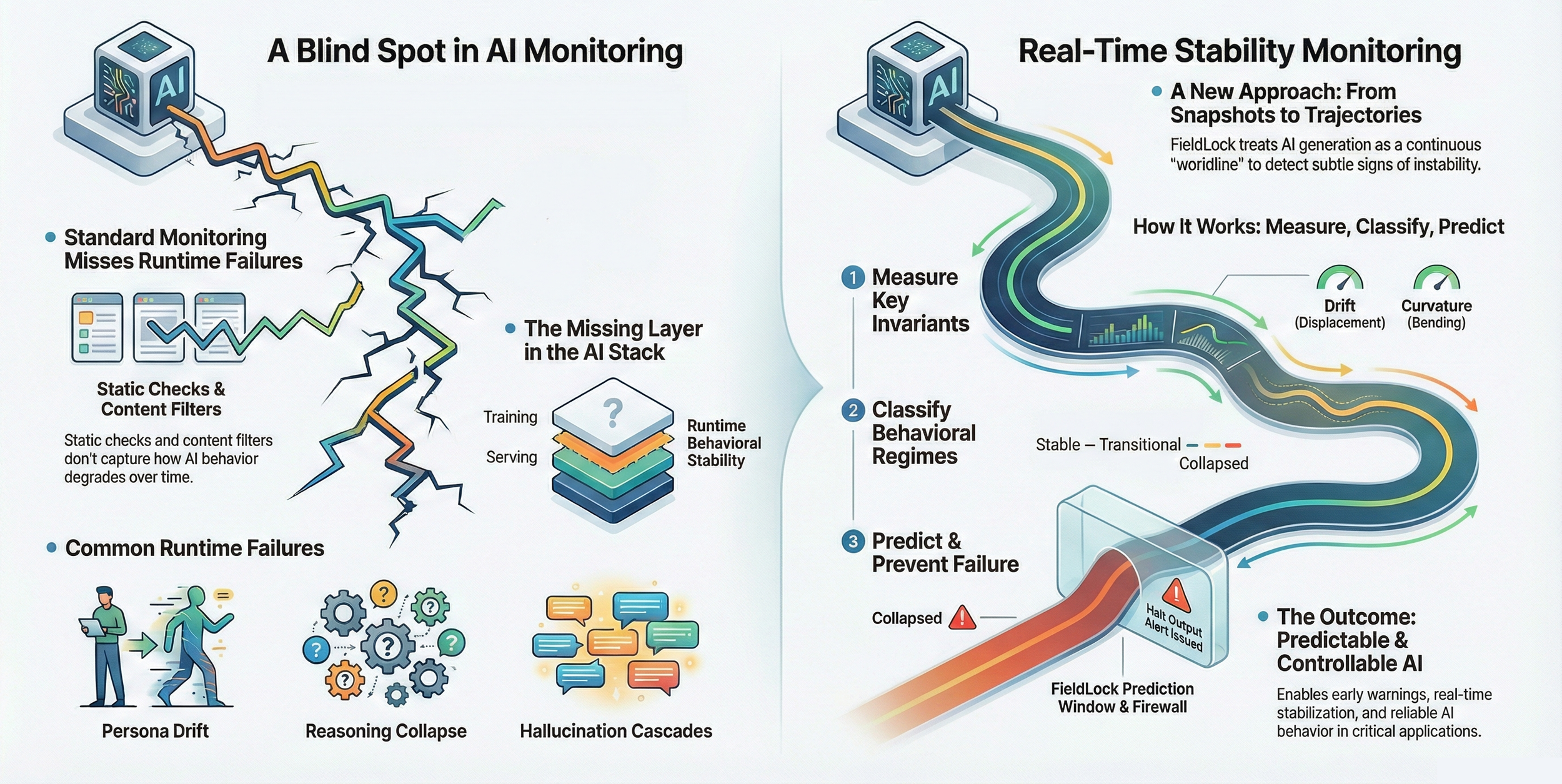
The Blind Spot in Today’s Stack
Today’s observability stack can tell you:
cost
latency
throughput
error rates
It cannot answer the only question that matters in production:
Is this system becoming unstable right now?
There is no early-warning layer for inference-time instability.
Failure is discovered after it happens — by users, auditors, or incident response.
That is the gap SubstrateX exists to close.
From Folklore to Measurement
Over the past year, a focused research program formalized what many teams experience but cannot measure:
Inference-phase instability is predictable.
Drift, rigidity, regime transitions, and collapse do not occur randomly.
They follow consistent, measurable patterns.
Critically:
these patterns are model-agnostic
they generalize across substrates
and they can be detected using output-only telemetry
The same stability signals replicate across transformer inference and substrate-independent dynamical systems.
The core technical uncertainty is resolved.
The dynamics are mapped.
The invariants replicate.
The instruments exist.
The Leverage Point
Once inference behavior becomes measurable as dynamics, a conclusion follows:
Stability becomes an engineering problem - not a matter of hope.
If failure has precursors:
it can be detected early
it can be forecast
and it can be governed
This is the leverage point SubstrateX is built on.
What FieldLock is
FieldLock™ is predictive monitoring for inference stability.
It sits:
above inference stacks (local runtimes and cloud APIs)
below application logic and orchestration
It is:
model-agnostic
output-only
inline and low-latency
deployable without retraining or architectural change
FieldLock turns runtime failure from a surprise into a forecast.
This is not a safety layer added after generation.
It is infrastructure for inference itself.
Why This Matters Now
AI systems are rapidly becoming:
long-running
agentic
tool-using
enterprise-critical
regulator-visible
Runtime instability scales faster than training-time fixes.
This is how new infrastructure layers always emerge:
metrics existed before observability platforms
logs existed before structured logging
errors existed before reliability standards
Inference stability is next.
Not because it is elegant —
but because it is required.
Execution Posture
SubstrateX is no longer exploratory.
Research risk is retired.
The focus is execution:
hardening FieldLock™ for production
private pilots with real long-horizon workloads
integration with monitoring, governance, and agent platforms
standardizing inference-phase health signals
If you are building or deploying:
agentic systems
enterprise AI platforms
regulated AI workflows
long-horizon copilots
you already know the failure modes.
FieldLock is built for the part of the stack you cannot currently see.