

Managed Stability Monitoring
Evaluation & Synthesis Program
Governed runtime stability you can see, measure, and explain.
What This Is
The Evaluation & Synthesis Layer (ESL) is SubstrateX’s governed, runtime-native assessment of how AI systems actually behave over time.
It does not inspect weights or training data.
It does not benchmark capability or rank models.
Instead, ESL evaluates inference-phase behavior and produces a standardized, organization-ready artifact that answers one question:
How stable is this system as it operates in real conditions?
The result is a shared, defensible view of runtime stability that engineering, risk, and governance teams can all use.
Why Evaluation & Synthesis Layer Exists
Most organizations can tell you:
cost per request
latency and throughput
benchmark scores
Almost none can answer:
“Is this system becoming unstable as it runs?”
Runtime instability develops gradually and invisibly:
long-horizon drift
brittle lock-in
collapse under recursion or tool use
Logs and benchmarks do not capture this.
ESL exists to make runtime stability measurable and governable, without requiring model access or architectural change.
Why Evaluation & Synthesis Layer Exists
Most organizations can tell you:
cost per request
latency and throughput
benchmark scores
Almost none can answer:
“Is this system becoming unstable as it runs?”
Runtime instability develops gradually and invisibly:
long-horizon drift
brittle lock-in
collapse under recursion or tool use
Logs and benchmarks do not capture this.
ESL exists to make runtime stability measurable and governable, without requiring model access or architectural change.
What Evaluation & Synthesis Analyzes
Depending on engagement scope, ESL is produced using one or both of the following inputs:
Instrumented Runtime Assessments
Time-limited, controlled probe runs against defined workloads to observe stability behavior under realistic conditions.
Governed Log & Output Analysis
Reconstruction of runtime trajectories from approved telemetry, transcripts, and metadata.
In both cases, analysis focuses exclusively on inference-phase behavior — not prompts, weights, or training artifacts.
What You Receive
Each Evaluation & Synthesis engagement produces a canonical, governed bundle per system or workload.
1. Executive & Governance Summary
A non-technical view of runtime stability:
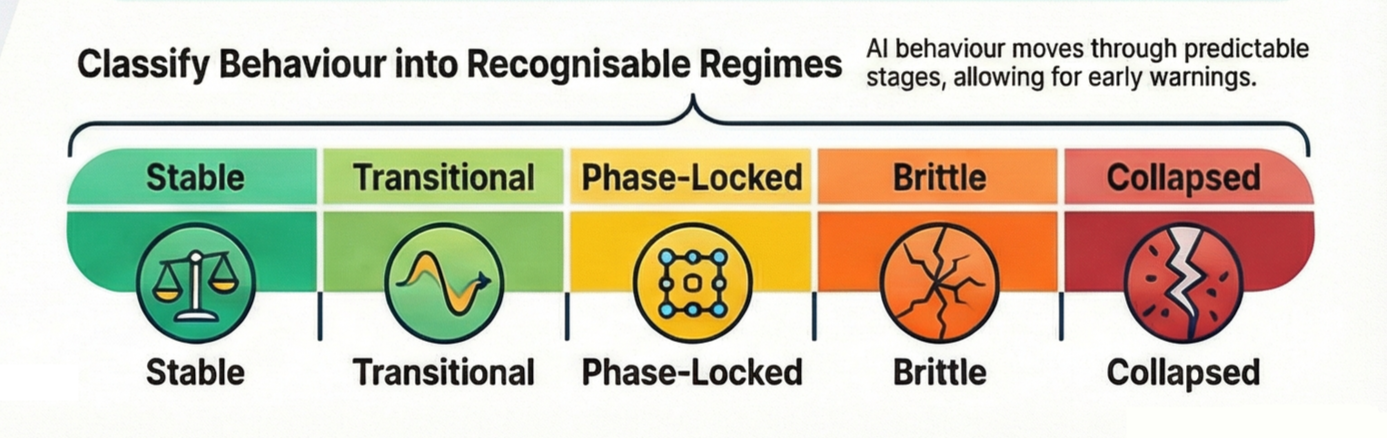
distribution across stability regimes
where behavior is predictable
where drift, brittleness, or collapse occurs
readiness tier for deployment and scale
2. Technical ESL Report
Engineering-facing analysis, including:
regime timelines and transitions
stability posture across horizons, tasks, and tools
catalog of instability events and triggers
comparative views across configurations
3. ESL Data Artifact
A machine-readable, governed output (e.g., JSON / Parquet) that enables:
internal tracking over time
comparison against future runs
integration into dashboards or risk workflows
How the Program Runs
Phase 1 —
Scoping & Governance
Define systems, workloads, data boundaries, and privacy constraints.
Phase 2 —
Runtime Analysis
Apply a consistent measurement and classification pipeline to observed behavior.
Phase 3 —
Synthesis & Review
Deliver ESL artifacts and walk through findings with engineering and risk leads.
Optional guidance includes:
where stability gains are highest
which changes reduce risk fastest
what is safe to scale now vs later
Why Evaluation & Synthesis Layer Matters
Evaluation & Synthesis Layer provides:
Evidence, not anecdotes
Stability quantified over real workloadsA shared language
One artifact for engineering, risk, and governanceA bridge to continuous monitoring
The same ESL rubric underpins FieldLock’s live stability layer
Because Evaluation & Synthesis Layer provides:
avoids model internals
respects strict data governance
focuses on runtime behavior, not capability marketing
it is a low-regret, high-signal entry point into inference-phase governance.
How To Engage
If you already know that tokens, cost, and benchmarks are not enough, Evaluation & Synthesis is the missing artifact.