

Validation Pilot
Decision-Grade Runtime Stability Evidence
What the Validation Pilot Is
The SubstrateX Validation Pilot is a time-boxed, governed engagement designed to answer one operational question:
Is runtime inference instability present in your system - and can it be detected early enough to matter?
This is not a demo.
This is not exploratory research.
This is not a generic evaluation.
It is read-only, inference-phase instrumentation applied to a real system, under real workload conditions, to produce evidence you can act on.
The Validation Pilot is the required prerequisite for:
ESL reporting
FieldLock infrastructure deployment
any ongoing stability or governance program
Why the Validation Pilot Exists
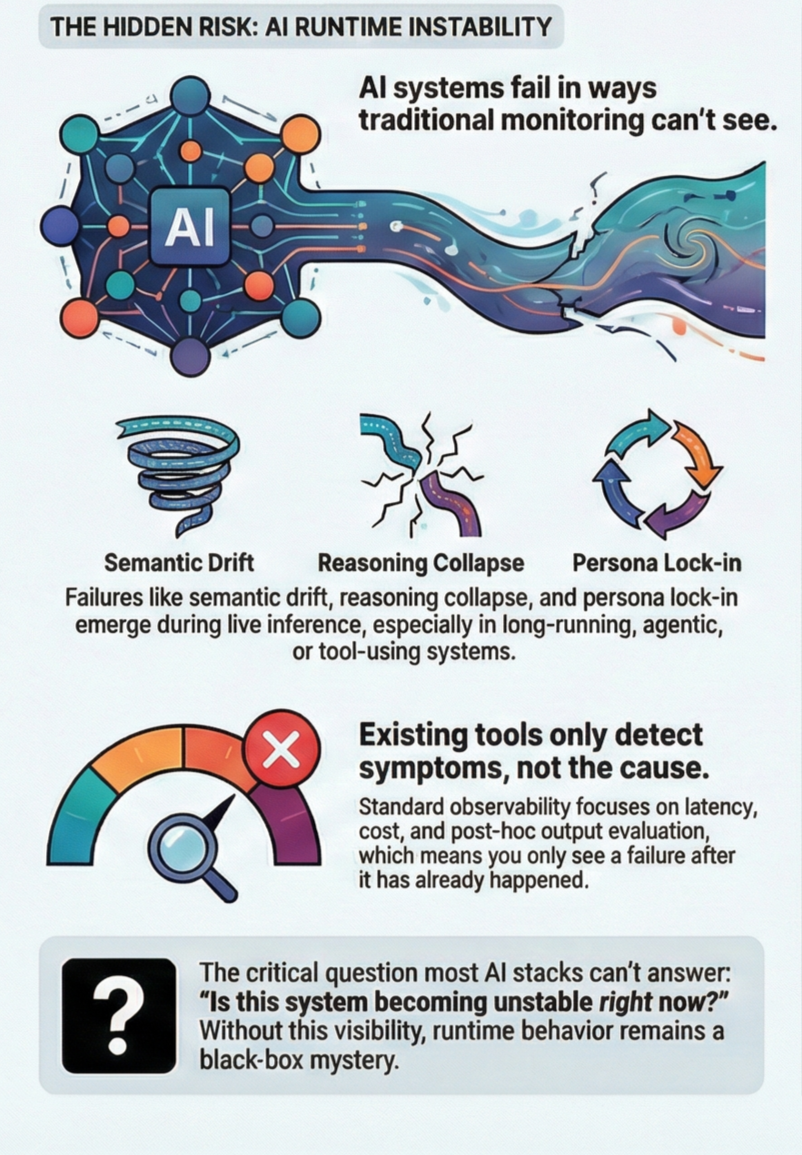
Most organizations know AI systems can fail at runtime.
Very few can prove:
whether instability is actually present
when it begins
whether it is observable without internal access
or whether intervention would be possible in time
The Validation Pilot exists to replace assumptions with measurement.
The outcome is not a dashboard.
The outcome is a defensible decision artifact.
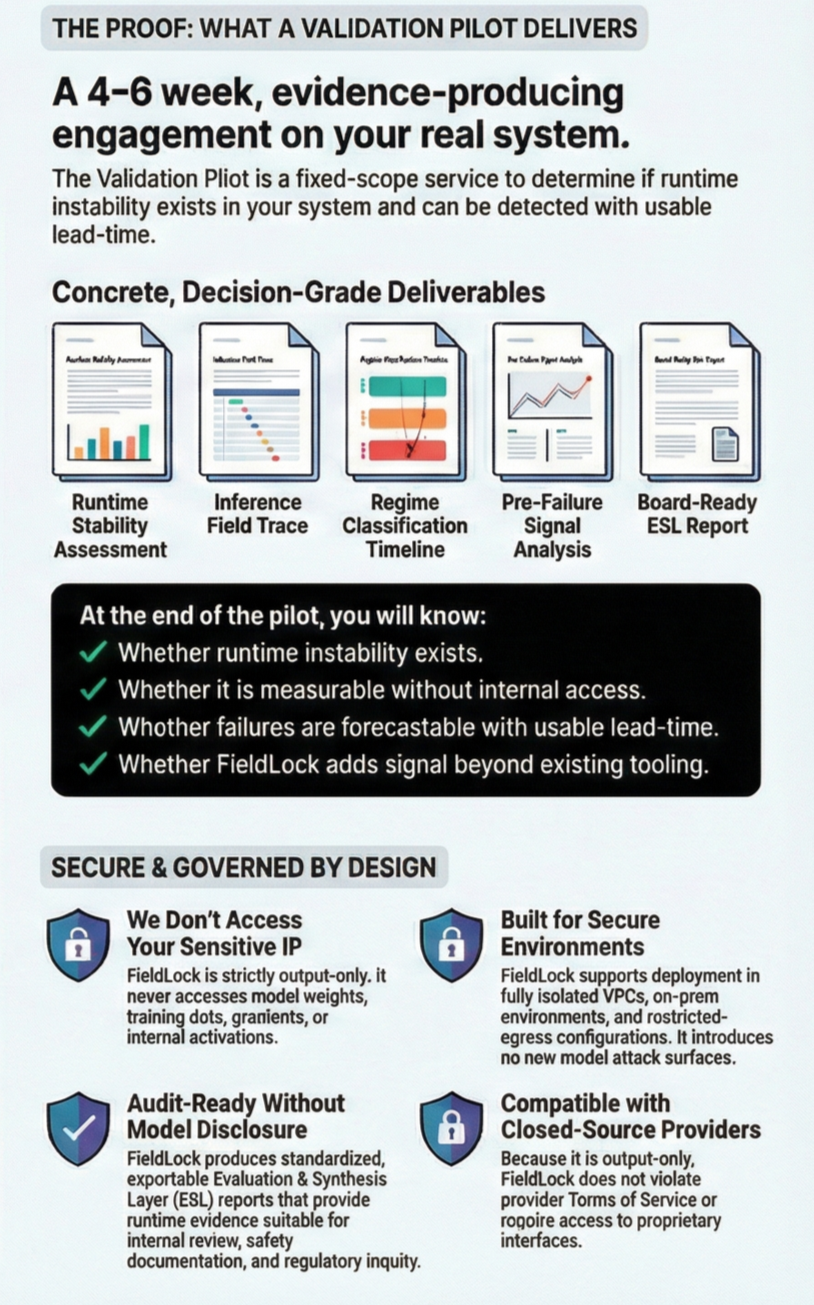
What the Pilot Delivers
Each Validation Pilot produces a fixed, governance-ready output set.
-
A system-level characterization of:
stability under sustained inference
where Stable, Transitional, Phase-Locked, Collapse, and Recovery regimes occur
how behavior shifts with horizon, recursion, and tool use
This establishes whether instability exists - and where.
-
A reconstructed, time-ordered worldline of runtime behavior derived from:
output-only telemetry
controlled probe runs (when appropriate)
No weights.
No training data.
No internal activations.This trace is the empirical backbone of all downstream analysis.
-
Identification of:
regimes observed
transition triggers
dwell times and recurrence patterns
This timeline compresses directly into standardized ESL form.
-
Analysis of deformation patterns that reliably appear before:
hallucination spikes
agent runaway
reasoning collapse
catastrophic mode-lock
This defines usable lead-time, not post-mortems.
-
A governed ESL bundle that:
summarizes regime distribution and stability posture
presents risk and readiness tiers
is structured for engineering, risk, and regulatory audiences
is comparable across future runs and systems
This report is exportable, auditable, and board-ready.
-
Analysis of deformation patterns that reliably appear before:
hallucination spikes
agent runaway
reasoning collapse
catastrophic mode-lock
This defines usable lead-time, not post-mortems.
Scope & Constraints
To preserve signal quality and interpretability, each pilot is intentionally narrow:
one system (model or model stack)
one workload class (agent, chat, planning, tool use, etc.)
one deployment context (staging or defined production slice)
This keeps operational risk low and conclusions defensible.
What the Validation Pilot Does Not Do
To be explicit, the Validation Piloat does not involve:
access to model weights
access to training data
inspection of internal activations
modification of inference behavior
alignment tuning or policy control
The pilot runs in strict observe-only mode.
Measurement precedes intervention.
First we prove instability is visible. Only then do we discuss control.
Duration & Structure
Typical duration: 4–6 calendar weeks
Phase 1 — Scoping & Alignment
System selection, workload definition, governance constraintsPhase 2 — Live Observation
Read-only instrumentation alongside normal operation or replayPhase 3 — Analysis & Classification
Regime extraction, signal validation, normalizationPhase 4 — Reporting & Review
Delivery of Runtime Stability Assessment and ESL bundle
Joint review with engineering, risk, and governance stakeholders
Who the Validation Pilot Is For
The Validation Pilot is appropriate if you:
operate long-running, agentic, or tool-using AI systems
rely on AI for business-critical or safety-relevant decisions
face governance or regulatory scrutiny
are no longer satisfied with “we tested it once and it looked fine”
Typical initiators include:
AI / ML platform teams
SRE and reliability engineering
safety, risk, and compliance groups
applied research and advanced development labs
What You Know at the End
By the end of the Validation Pilot, you will know:
whether runtime instability exists
whether it is measurable without internal access
whether failures are forecastable with usable lead-time
whether FieldLock adds signal beyond existing tooling
whether broader deployment is warranted
Regardless of outcome, you leave with a defensible runtime stability narrative grounded in measurement.
Call to Action
➡️ Request a Validation Pilot
➡️ Speak with the Founding Team
Platform Note
The Validation Pilot is the bridge between:
the science of inference-phase behavior, and
the infrastructure required to operate AI systems with measurable stability
It is the first step in moving from assumed reliability to engineered stability.