

Runtime Incident Reconstruction & Forensics
Understand what happened - and whether it was already unstable before it did.
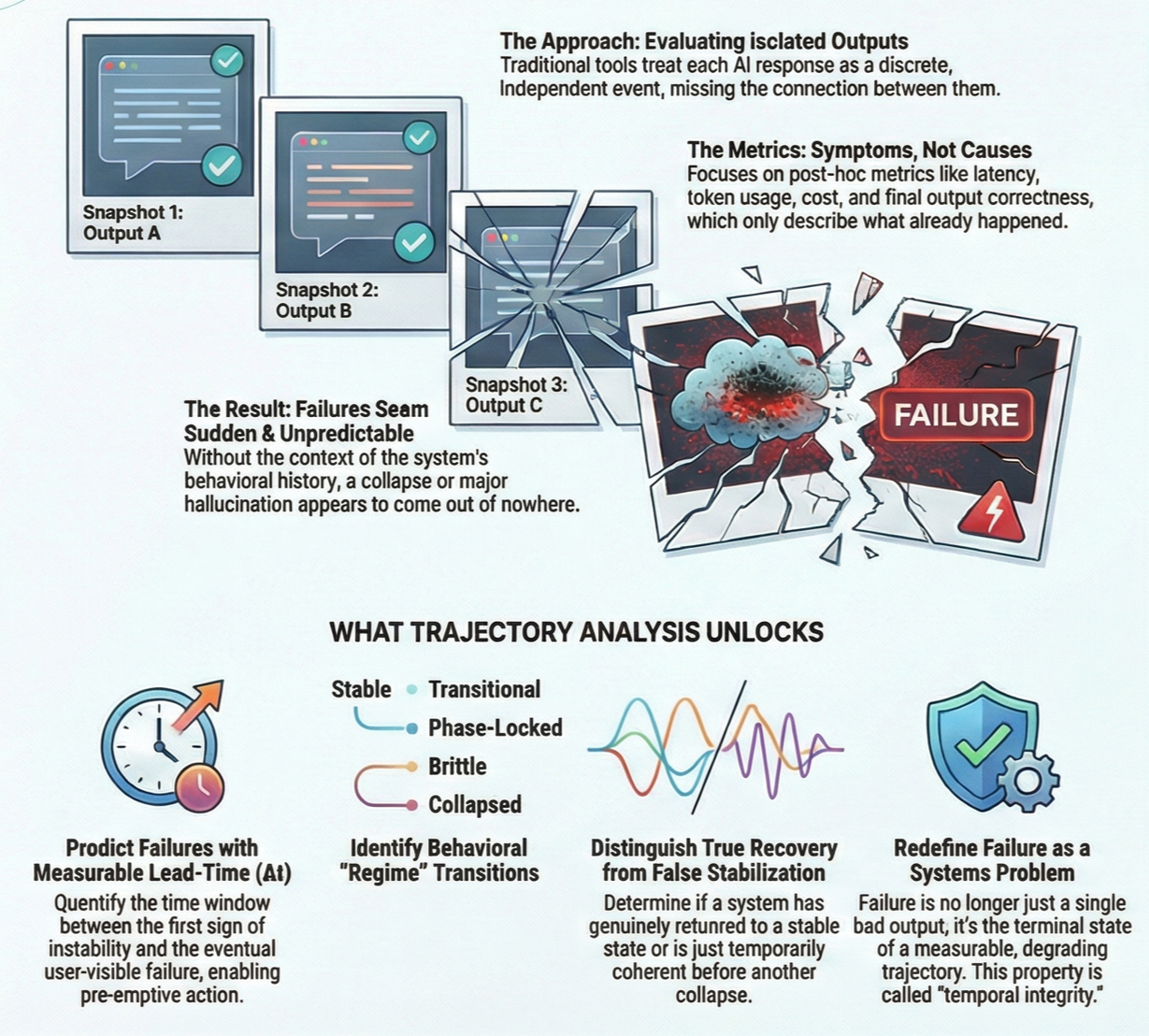
Traditional AI forensics can show what a system did.
Runtime field forensics can show whether the system was already unstable when it did it.
This service reconstructs AI incidents at the inference-phase, where logs and metrics go blind.
What This Is
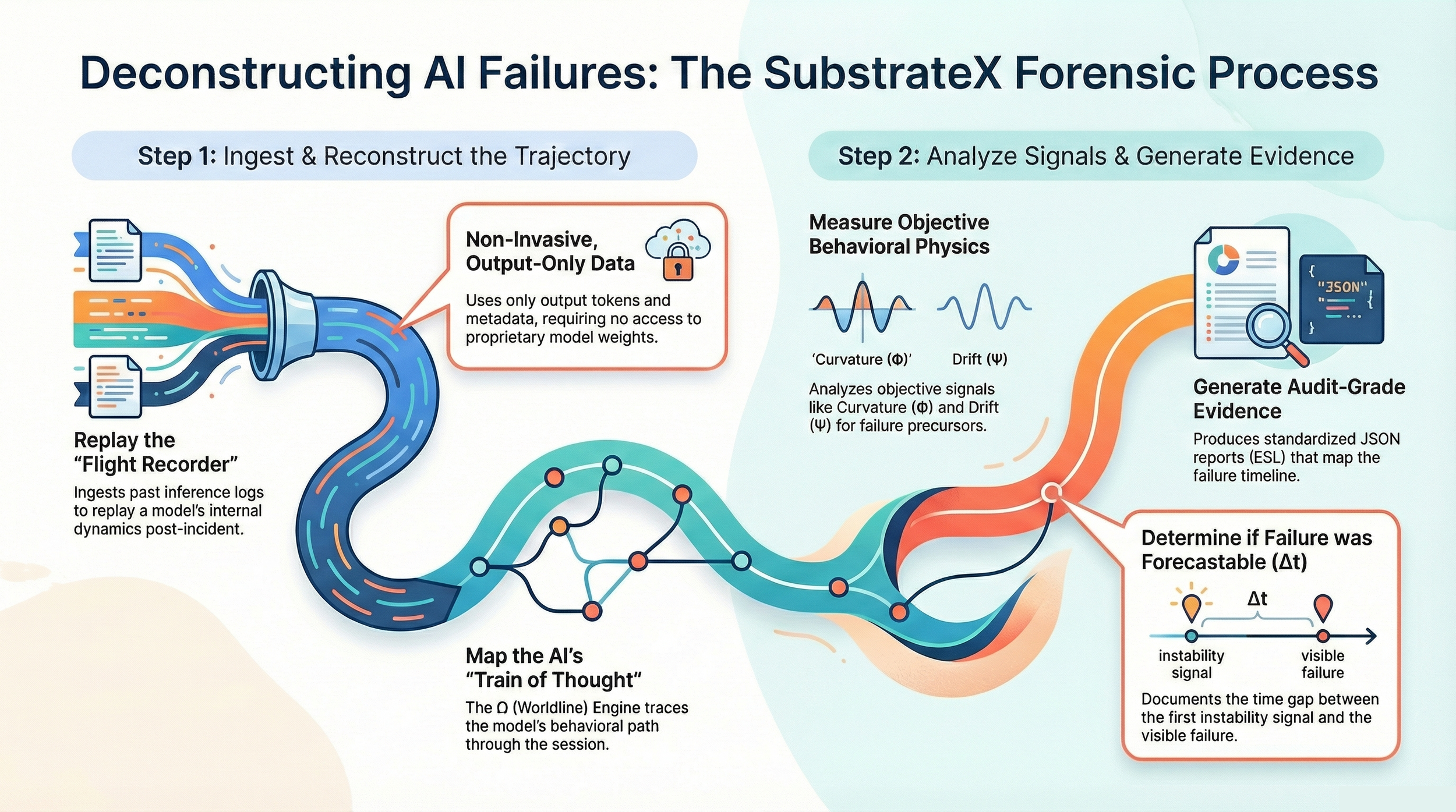
Runtime Incident Reconstruction & Forensics is a focused SubstrateX engagement that rebuilds a real AI incident as a runtime field event.
Using your governed telemetry - and, where available, FieldLock™ / ESL traces - we reconstruct:
when the system first left a Stable regime
how long it operated in Transitional or Phase-Locked states
which stability signals deviated before failure became visible
what changed between nominal behavior and the incident window
This is not generic debugging.
It is post-incident inference-phase analysis.
Why It’s Valuable
Most AI incidents are described in vague terms:
“The agent went off the rails.”
“The model suddenly became brittle.”
“We saw cascading hallucinations.”
Those descriptions don’t explain what actually changed.
Runtime Incident Reconstruction:
turns opaque failures into structured, explainable events
shows how far back instability began — not just where it surfaced
identifies precursor signals you can monitor next time
The output feeds directly into:
future FieldLock alert thresholds
ESL risk history and baselining
board, audit, and regulatory reporting
You leave with a defensible answer to:
What happened, when did it start, and could we have seen it coming?
Why Logs Aren’t Enough
Traditional tools can tell you: which endpoint failed or which step produced an error.
They cannot tell you how the system’s behavior was deforming over time.
SubstrateX reconstructs the runtime worldline of the incident - the invisible trajectory that led to failure -
using stability regimes, deviations, and temporal dynamics that conventional observability does not capture.
This is the only incident analysis built on inference-phase dynamics, not surface metrics.
What This Service Does Not Do
This service does not:
modify your models or prompts
tune agents or policies
replace SRE or postmortem processes
provide legal or compliance sign-off
It is a field-level analytical layer that integrates with existing incident management.
When to Use This Service
A Runtime Incident Reconstruction is appropriate when:
a visible failure occurred (hallucination, runaway loop, tool misuse, collapse)
logs and traces exist, but don’t explain why
internal reviews answered what, not how instability formed
It is especially effective when:
a FieldLock Validation Engagement has already run, or
telemetry can be mapped into the ESL schema
What You Receive
Each engagement produces a consistent, governance-ready artifact set:
Incident Worldline Reconstruction
Regime Timeline & Transitions
Deviation & Precursor Signal Analysis
Baseline vs Incident Comparison
Incident ESL Summary
Forward Recommendations (non-binding)
All outputs use the same invariant and regime canon as FieldLock, enabling comparison across incidents and future runs.
Engagement Structure
Typical: 2–4 Weeks
Phase 1 —
Scoping & Governance
Incident window, data envelope, access constraints, stakeholders
Phase 2 —
Data Mapping
Normalize telemetry and align to invariant / regime inputs
Phase 3 —
Reconstruction & Analysis
Rebuild the incident worldline and identify deviations
Phase 4 —
Report & Review
Deliver artifacts and review with engineering, SRE, and governance teams
Optional outcomes:
recommendation for Validation Engagement
guidance on permanent FieldLock deployment
How to Engage
Because incidents are sensitive, every engagement begins with a confidential call.
➡️ Request an Incident Reconstruction
➡️ Speak with the Founding Team
We will help you turn an opaque failure into a measurable, explainable runtime event — and use it to harden what you build next.